Not how many you hold.
What share of the market.
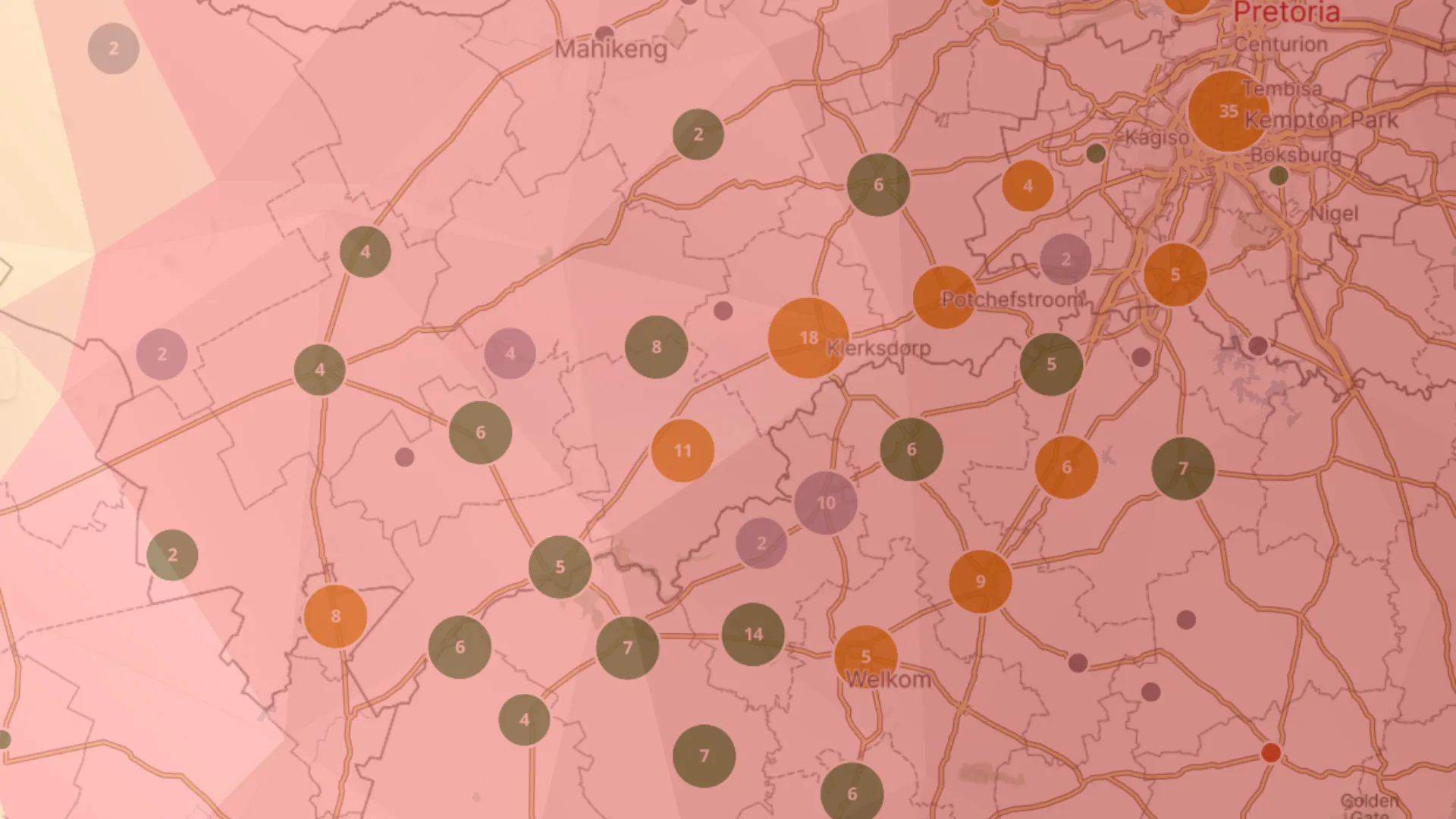
Load your customer book and ALR measures it against the market around it. It may hold half a million mortgages, a national policy book, a loyalty base in the millions, every record geocoded and set against the households in its own neighbourhood.
Penetration, not just presence
Knowing you hold 3 200 customers in a suburb, like Moreleta Park, means very little on its own. Knowing there are 8 400 residential properties there, and that 5 800 of them sit in the bands you actually serve, turns that number into market share, at neighbourhood level and nationally.
Riskscape holds the denominator. Households, income bands, property values and life stage for every neighbourhood in the country, built from the pixel up. Your book supplies the numerator. The result is a share-of-market read no customer list can produce on its own.
Penetration by neighbourhood
White space
Book concentration
Segmentation without a survey
Book against network
A book that moves
Two books. One measure.
The same penetration read serves an insurer's policy book and a retailer's loyalty base.
Banks, short-term and life insurers
- Mortgage book exposure by flood, fire and hazard band
- Policy accumulation inside a single event footprint
- Which areas the book is growing in, and which it is leaving
- Customer density measured against branch and ATM coverage
- Collateral quality by area, not by declared value alone
- Portfolio segmentation for pricing and campaign targeting
- The same view extended to the broker channel, scoped per brokerage
Retail and franchise networks
- Loyalty base mapped to neighbourhood, live
- Share of the catchment you actually hold, store by store
- Which stores draw from where, giving real catchments rather than radii
- Overlap between stores, measured from customer origin
- Where a new store would find customers rather than steal them
- Suburbs that match your strongest trade areas and hold no members
Give the same view to your brokers
An insurer's book arrives through brokers. Expose ALR to the broker network, scoped so each brokerage sees only its own clients. The risk conversation then moves to the front of the process, where it is still cheap to have.
Before the quote is promised
The broker enters an address and gets flood, fire, crime, emergency access and property detail back immediately, while the client is still on the phone.
Your rules travel with the view
Hazard band limits, concentration caps and referral triggers are set by you. The broker sees that a risk falls outside appetite before submitting it, not three days later.
A clean, scored submission
Geocoded, confidence-graded and carrying the same figures the underwriter will see. No re-keying, no disputed addresses, no argument about whose flood map is right.
In the process
- Fewer referrals and fewer declines late in the process
- Submission quality improves before it reaches underwriting
- One version of the risk, shared by broker and insurer
In the channel
- Brokers manage their own book, covering renewals, penetration and growth
- The insurer sees channel performance by area and by brokerage
- Appetite is communicated by the tool rather than by circular
Scoped access. Each brokerage sees only its own book - the insurer sees the whole channel - one model, one version, one set of numbers.
Handled properly.
Customer books are personal information under POPIA. Riskscape acts as an operator, processing on your behalf under written mandate.
What is kept, and what never is
Our full data-handling position is available on request. It covers the treatment of each line of business and the controls behind it. We are happy to work through a privacy impact assessment with your team before any data moves.
Go deeper.
The other parts of ALR, each on its own page.
Send us an extract.
A de-identified sample of the book is enough, being addresses and a reference. We will map it, measure penetration against the market around it, and show you the white space before the call.